
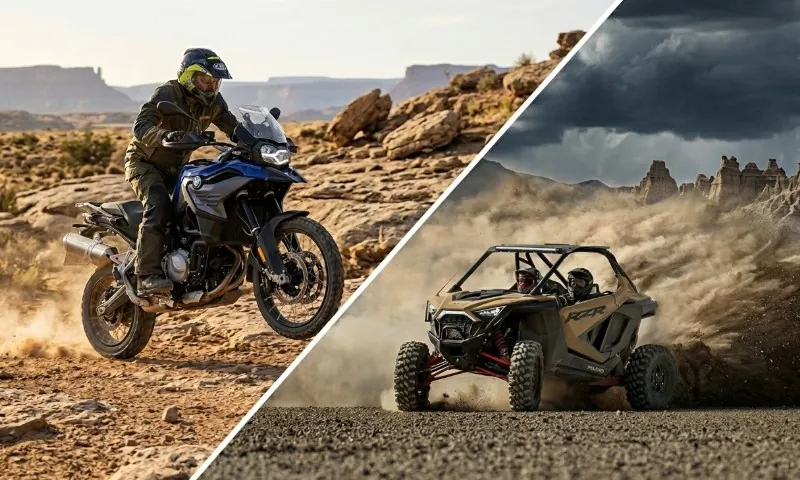
BMW F 900 GS and Polaris RZR XP 1000 both promise serious off-road fun, yet they serve very different riders. The BMW suits riders who want distance, balance, trail skill, and road legality in one adventure bike. The Polaris suits drivers who want stability, speed across rough terrain, a passenger seat, cargo space, and a side-by-side experience built around four wheels.
The better choice depends on where the ride starts. A mountain pass with paved sections, gravel roads, and remote fuel stops favors the F 900 GS. A desert trail, forest loop, dune area, ranch route, or OHV park favors the RZR XP 1000.
Quick Spec Comparison
Manufacturer data shows how far apart both machines are before anyone even starts the engine: BMW builds around motorcycle agility and mixed-surface travel, while Polaris builds around four-wheel traction, suspension travel, and cabin-based control.
| Category | BMW F 900 GS | Polaris RZR XP 1000 Ultimate |
| Vehicle type | Adventure motorcycle | Recreational side-by-side |
| Engine | 895 cc 2-cylinder | 999 cc ProStar twin-cylinder |
| Power | 105 hp at 8,500 rpm | 114 hp |
| Torque | 93 Nm at 6,750 rpm | Not listed by Polaris |
| Drive | Chain drive | On-demand AWD/2WD |
| Transmission | Manual motorcycle gearbox | Automatic PVT |
| Weight | 219 kg road-ready | 1,753 lbs curb weight |
| Fuel capacity | 14.5 L | 9.5 gal, 35.9 L |
| Front / rear travel | 230 mm / 215 mm | 16 in / 18 in wheel travel |
| Ground clearance | Depends on load and setup | 14.5 in |
| Seats | 1 rider, passenger possible | 2 occupants |
BMW F 900 GS: Off-Road Skill With Real Travel Range
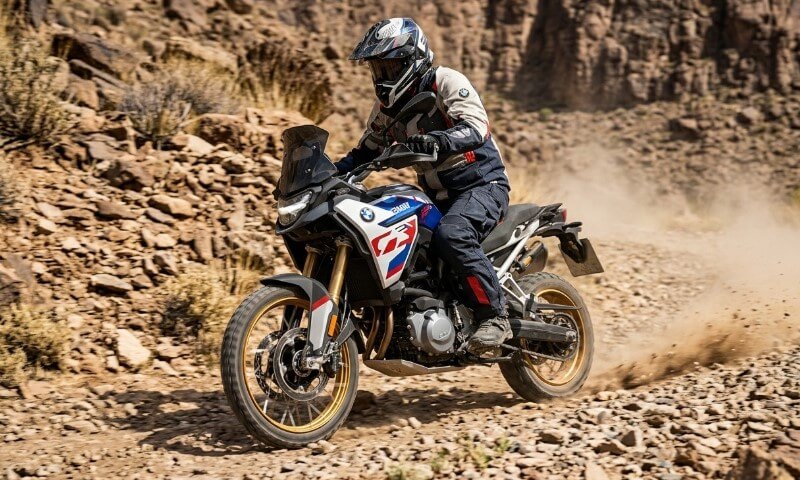
The F 900 GS is the more demanding machine. It rewards technique, body position, throttle control, and good line choice. A rider has to manage balance, clutch, rear brake, standing posture, and traction at the same time.
BMW gives it a 895 cc twin-cylinder engine with 105 hp and 93 Nm of torque. The bike uses a 21-inch front wheel, a 17-inch rear wheel, cross-spoke rims, and long suspension travel, with 230 mm up front and 215 mm at the rear. Road-ready weight is listed at 219 kg, and fuel capacity is 14.5 L.
Those numbers matter because adventure motorcycles live in compromise. A lighter enduro bike may feel easier in deep mud or tight single-track. A large touring bike may feel calmer on highways.
The F 900 GS sits between those worlds, with enough power for long pavement stretches and enough chassis focus for gravel, rocky roads, and moderate trail riding.
Where The BMW Feels At Home
The F 900 GS makes sense for riders who want one machine to connect distant places. Picture a weekend route with 200 highway miles, a forest service road, a rocky overlook, a fuel stop in a small town, and another paved stretch home.
That type of ride is exactly where an adventure bike earns its keep.
Strong use cases include:
- Long gravel routes
- Backcountry travel with paved connectors
- Solo exploration
- Lightweight luggage trips
- Remote roads where width matters
- Riders who enjoy active body control
BMW also fits useful electronics into the package. Standard equipment includes ABS Pro, Dynamic Traction Control, riding modes, heated grips, hand protectors, engine guard, LED lighting, and a 6.5-inch TFT display.
Optional riding modes add Enduro and Enduro Pro, aimed at riders who want sharper control away from pavement.
Polaris RZR XP 1000: Fast, Stable, And Built For Rough Play
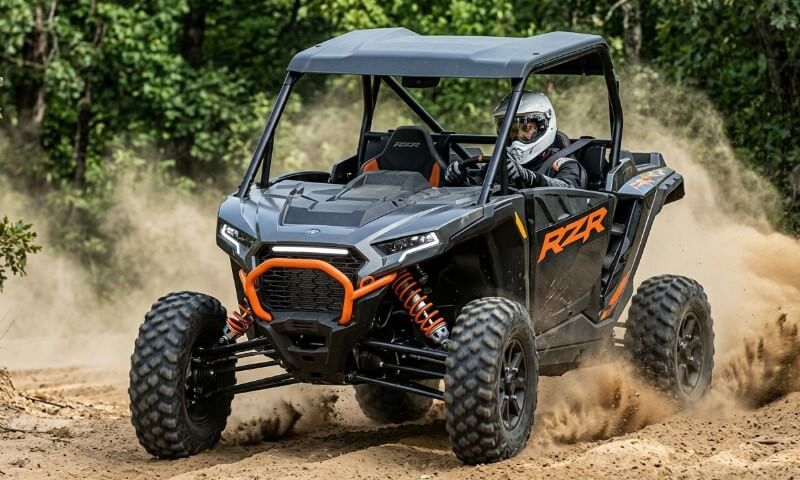
The RZR XP 1000 comes from a different school of off-roading. The driver sits in a bolstered seat, uses a steering wheel and pedals, and lets the suspension absorb impacts that would exhaust a motorcycle rider.
Visibility also becomes part of that cabin-style control. Upgrades such as UTV mirrors can make trail driving feel more composed by helping the driver keep track of passengers, traffic behind the vehicle, and nearby obstacles on tight routes.
Polaris lists the 2026 RZR XP 1000 Ultimate with a 999 cc ProStar twin-cylinder engine, 114 hp, on-demand AWD/2WD, and an automatic PVT transmission with park, reverse, neutral, low, and high. Ground clearance is 14.5 inches, curb weight is 1,753 lbs, payload capacity is 740 lbs, and the vehicle carries 2 people.
Suspension is a major part of the RZR’s personality. Polaris lists 16 inches of front wheel travel and 18 inches at the rear, with Walker Evans needle shocks and adjustable clickers.
The Ultimate trim also gets 30-inch radial tires, 8-ply construction, a 7-inch Ride Command display, GPS mapping, rear camera, audio, electric power steering, and an integrated 4,500-lb winch.
Where The Polaris Makes More Sense
The RZR XP 1000 is for riders who want off-road speed with less physical balancing work. It suits wide trails, dunes, open desert, rocky OHV routes, and recreational riding with a passenger.
Its footprint is much wider than a motorcycle, at 64 inches, so tight gates, narrow forest paths, and motorcycle-friendly single-track are out. Yet on routes built for side-by-sides, the RZR gives drivers a level of confidence that a tall adventure bike cannot match.
Good use cases include:
- OHV parks
- Desert trails
- Dunes
- Ranch or cabin routes
- Two-person recreational rides
- Rough terrain where suspension travel matters more than narrow size
Handling: Balance Against Stability
View this post on Instagram
BMW handling depends on the rider. On loose climbs or rocky tracks, a skilled rider can pick a narrow line, stand on the pegs, steer with foot pressure, and lift over obstacles.
A less experienced rider may find the seat height, weight, and clutch work tiring after repeated low-speed mistakes.
The RZR reverses that relationship. Its four-wheel stance gives immediate stability, especially at low speed. The driver does not balance the machine. Steering is familiar to anyone with car experience, and the automatic transmission removes clutch work.
The tradeoff appears in tight terrain. A motorcycle can squeeze through ruts, around fallen branches, and along narrow shelf roads. A side-by-side needs space. When the route narrows, the BMW starts to feel free while the Polaris starts to feel large.
Comfort And Passenger Experience
The F 900 GS can carry luggage and a passenger, but its best off-road character appears with one rider and modest gear. Standing riding, weight shifts, and rough terrain make two-up off-road motorcycling a specialist activity.
The RZR XP 1000 is far better for shared off-road recreation. Two bucket seats, seat belts, a roof, door coverage, cargo bed space, audio, GPS, and rear camera support a more social ride. A passenger can relax more, talk, look around, and stay belted inside the cabin.
That difference changes the whole mood. BMW feels personal and focused. Polaris feels shared and recreational.
Safety And Responsibility Off-Road
Both machines require training and restraint. The BMW has motorcycle-specific risk, especially on mixed surfaces where braking grip changes quickly.
IIHS research found motorcycle ABS associated with a 22% reduction in fatal crash involvement rates per 10,000 registered vehicle years, which helps explain why modern adventure bikes place so much emphasis on ABS and traction electronics.
The Polaris has a different risk profile. CPSC guidance for recreational off-highway vehicles says occupants should avoid paved roads, wear helmets and protective gear, fasten seat belts, keep all body parts inside the vehicle, and never exceed the number of seat belts.
Rollover risk deserves special attention. CPSC’s review of ROV incidents found rollover in 68% of reported incidents and said 91% of fatally ejected victims were not wearing seat belts. That makes seat belt use, controlled speed, and terrain judgment central to any RZR ride.
Land access matters as much as machine choice. The U.S. Forest Service tells off-highway users to travel only on designated routes, avoid cross-country travel, follow signs, and wear helmets and protective gear.
Ownership Reality: Street Access, Transport, And Storage
The BMW wins on flexibility. In many markets, it can be registered for road use, ridden from home, filled at normal gas stations, and parked like a large motorcycle. A rider can leave before sunrise, cover highway miles, ride gravel all day, and return without a trailer.
The RZR usually needs a truck, trailer, storage space, ramps, tie-downs, and legal OHV access. That adds cost and planning. The upside is durability in dedicated off-road terrain and less physical strain over rough ground.
Maintenance differs as well. BMW ownership revolves around motorcycle service, tires, chain care, brake wear, oil changes, electronics, and crash protection. Polaris ownership adds belts, suspension components, CV joints, tires, body panels, winch gear, air filters, and more drivetrain parts exposed to dust, water, and impact.
Which One Should You Choose?
Choose the BMW F 900 GS when the route includes pavement, gravel, distance, travel gear, and narrow backroads. It suits riders who want skill-based control and a machine that can move from highway to trail without needing a trailer.
Choose the Polaris RZR XP 1000 when the ride centers on dedicated off-road terrain, rough trails, dunes, passenger comfort, and four-wheel stability. It suits drivers who want speed, suspension travel, and cabin-style confidence across terrain designed for side-by-sides.
Neither machine replaces the other. The BMW turns off-road travel into a rider’s craft. The Polaris turns rough terrain into a controlled, high-traction driving experience. Same dirt, different mindset.