

Lab sample transport looks simple from the outside: pick up a bag, drive it across town, hand it to specimen receiving. In practice, a courier is carrying a small clinical decision point.
A leaking tube, missed temperature range, wrong patient label, or broken handoff record can delay care, force recollection, or compromise a result.
Rules around lab sample courier work sit across several areas: hazardous materials transport, bloodborne pathogen safety, packaging, driving policy, specimen integrity, and chain of custody. A good courier program treats all of them as one system.
Why Lab Sample Transport Carries Real Risk
@securethecontracts Everybody talks medical delivery… nobody talks IC specimen paths. This is where drivers scale FAST. These lab runs? Pathology specimen paths? That’s the contract lane nobody warned you about. #lab #courier #securethecontracts #medicaldelivery #medicalcourier
Most routine clinical samples are not dramatic. Blood tubes, urine cups, swabs, stool containers, tissue pots, and microbiology specimens move through healthcare networks every day. Risk appears when routine handling gets sloppy.
OSHA’s bloodborne pathogens standard requires blood and other potentially infectious material to be placed in containers that prevent leakage during collection, handling, processing, storage, transport, or shipping.
Once specimen containers leave a facility, OSHA also requires proper labeling or color coding unless an exemption applies only inside the facility.
Courier mistakes usually fall into a few predictable categories:
| Risk Area | Common Failure | Likely Result |
| Packaging | Loose cap, no absorbent, cracked tube | Leak, exposure risk, rejected specimen |
| Labeling | Missing second identifier | Recollection or delayed accessioning |
| Temperature | Wrong cooler, no cold pack, overheated vehicle | Degraded sample or invalid result |
| Chain of custody | No signature, missing time, broken seal | Questioned integrity |
| Vehicle safety | Unsecured cooler, distracted driving | Crash risk, spill risk, service failure |
For healthcare networks that also coordinate broader freight movement, smaller medical loads may require the same disciplined planning found in https://www.divinetrans.com/page/professional-transportation-of-less-than-truckloads
Category A, Category B, And Routine Clinical Samples
Courier teams need clear classification rules before any sample moves. Infectious substances are handled under transport rules that distinguish higher-risk Category A materials from Category B biological substances.
IATA says its Dangerous Goods Regulations help shippers classify, mark, pack, label, and document dangerous shipments for air transport, and its 2026 DGR edition took effect on January 1, 2026.
Category A applies to substances capable of causing permanent disability, life-threatening disease, or fatal disease in otherwise healthy humans or animals when exposure occurs. Suspected viral hemorrhagic fever specimens, for example, demand stricter packaging and transport controls.
CDC guidance for viral hemorrhagic fever clinical specimens calls for a triple packaging system: sealable primary container with absorbent material, watertight leak-proof secondary container, and compliant outer package for Category A shipping.
Category B covers infectious substances that do not meet Category A criteria. Many diagnostic specimens travel as Biological Substance, Category B, often linked to UN3373 marking under air or carrier rules.
FedEx guidance for clinical liquid samples gives a useful practical model: watertight primary receptacle, absorbent material able to absorb the full contents, secondary watertight packaging, and outer packaging.
Packaging Rules Couriers Should Treat As Non-Negotiable
Packaging is the first safety control. A courier should not fix poor collection work in a parking lot, yet they should know enough to reject unsafe pickups before loading them.
A sound setup includes:
- A tightly closed primary specimen container
- Absorbent material for liquid specimens
- A sealed biohazard bag or equivalent secondary container
- Requisition paperwork kept separate from the sample chamber
- Rigid outer transport container or cooler
- Clear handling condition, such as room temperature, refrigerated, or frozen
- Enough cushioning to prevent tube-on-tube breakage
The BCCDC Public Health Laboratory gives a practical submission model: samples need clear labeling with two identifiers, matching requisitions, tightly closed containers, absorbent material for liquid samples, and paperwork placed in the outside pouch rather than inside the same compartment as the specimen.
It also lists common rejection reasons, including leaking samples, unlabeled samples, identifier mismatches, wrong containers, blank requisitions, and contradictory information.
For a courier, the lesson is direct. Do not accept mystery bags. Do not mix loose paperwork with wet specimens. Do not place clinical samples and environmental samples in the same outer container unless a lab’s written policy allows it. Keep each test family and temperature class separated.
Temperature Control Protects The Result
Cold chain language often gets used loosely. Lab transport needs a sharper approach because different specimens need different conditions.
Some specimens need refrigeration. Others need room temperature. Some need freezing, and some can be damaged by accidental freezing.
CDC guidance for CD4 testing, for example, advises room-temperature transport at 64°F to 72°F, warns against freezing or overheating, and notes that temperatures above 99°F may damage cells and affect flow cytometry measurements.
A courier route should be planned around specimen stability, not only mileage. A short route through summer traffic can be worse than a longer route in a temperature-monitored vehicle.
Practical Temperature Controls
A competent courier operation should use:
- Dedicated coolers by temperature class
- Validated cold packs, not improvised grocery ice
- Temperature monitors or data loggers for sensitive routes
- Written loading diagrams for multi-stop routes
- Clear escalation rules for delays
- Documented temperature checks at pickup and delivery when required
“Keep cold” is not enough as an instruction. A driver needs the exact range, the container type, and the action to take when a route runs late.
Vehicle Safety Is Part Of Specimen Integrity
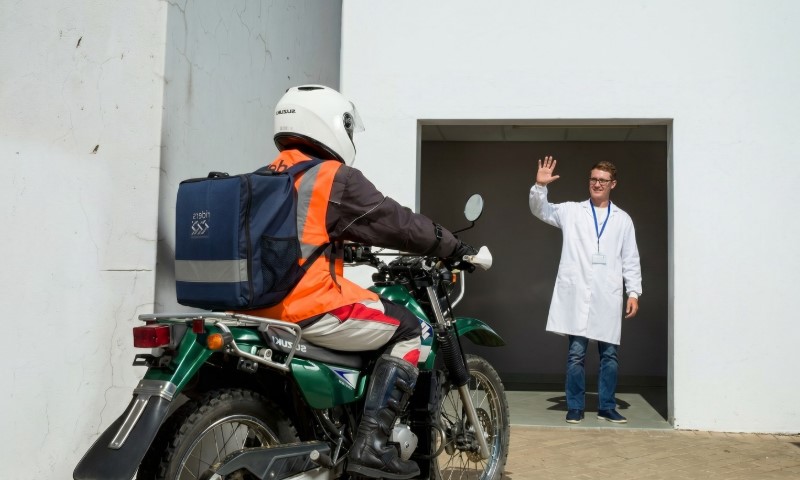
A lab courier vehicle is a mobile workplace. Poor driving policy can become a specimen safety problem. OSHA says preventing work-related roadway crashes requires traffic-safety principles plus sound safety management practices, including employer policies that promote safe driving behavior.
NIOSH also notes that workers face crash risk whether they drive light or heavy vehicles and whether driving is their main job or only part of the role. For couriers, that includes medical cars, vans, e-bikes, cargo bikes, and contracted drivers using personal vehicles.
Specimen containers should never ride loose on a seat. Coolers belong on a flat surface, secured against tipping or sliding. FMCSA cargo securement guidance for commercial motor vehicles says cargo must be firmly immobilized or secured by adequate structures, dunnage, tiedowns, or similar methods.
Even when a small medical courier car falls outside heavy trucking rules, the safety principle still applies.
NHTSA reported 3,208 deaths and more than 315,000 injuries in distracted-driving crashes in 2024. Courier dispatch systems should never push drivers to text, scan, reroute, or answer calls while the vehicle is moving.
Chain Of Custody Means More Than A Signature
Chain of custody matters most when a sample has legal, forensic, employment, toxicology, or high-consequence clinical value. It creates a documented history of who had control, when transfer happened, and whether seals remained intact.
Federal workplace drug testing rules define chain of custody procedures as documentation of specimen or aliquot integrity from collection to final disposition. Chain of custody documents must account for handlers, signatures, dates, and purpose of handling.
SAMHSA’s federal workplace drug testing guidelines also state that HHS-certified laboratories must use internal and external chain of custody procedures from receipt through testing, reporting, storage, and final disposition.
Each person handling or transferring a specimen or aliquot must complete the appropriate entries, and every handler must be identified.
For ordinary clinical samples, a formal forensic chain may not be required. Still, a basic custody record is good practice. It can include pickup time, driver name, site name, number of bags or coolers, seal number, temperature condition, delivery time, receiver name, and exception notes.
What Couriers Should Check Before Leaving A Pickup Site
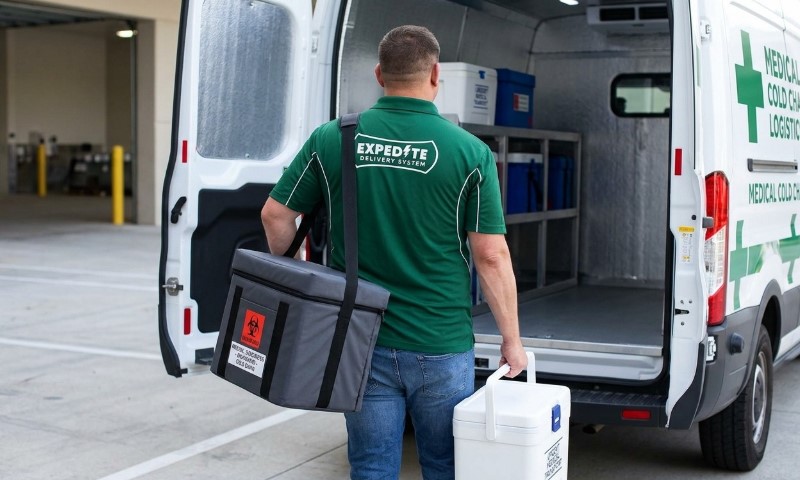
A courier should never perform clinical assessment, open primary containers, or correct patient identifiers. The role is transport control. Still, a pickup check can prevent obvious failures.
Basic Pickup Checklist
- Bag sealed
- No visible leakage
- Outer container clean and intact
- Requisition present where required
- Patient label visible or confirmed by site process
- Correct temperature container used
- Cooler secured before driving
- Pickup time recorded
- Any route exception documented immediately
When a specimen is leaking, unlabeled, warm when it should be cold, or missing required paperwork, the safest move is to follow escalation policy before departure. Silent acceptance shifts the problem downstream.
Training, Documentation, And Accountability
A courier program needs training matched to the samples being moved. Drivers handling blood and potentially infectious material need bloodborne pathogen awareness, exposure response procedures, spill response, PPE rules, and packaging recognition.
Anyone preparing regulated shipments may also need hazardous materials or dangerous goods training based on transport mode and classification.
Documentation should be boring, consistent, and easy to audit. That means no vague notes such as “sample okay.” Better notes record observable facts: “1 sealed refrigerated biohazard bag received from Suite 210 at 09:42, delivered to main lab receiving at 10:18, no visible leakage.”
Summary
Lab sample courier work depends on small disciplines repeated every day. Correct classification sets the rulebook. Packaging prevents exposure and rejection.
Temperature control protects test quality. Vehicle safety keeps the route from becoming the hazard. Chain of custody proves the sample that arrived is the sample that was collected.
When those pieces work together, courier transport becomes a quiet but essential part of reliable medicine.