


Motorcycle helmet laws in the United States depend on each individual state rather than a single federal mandate.
Riders crossing state lines can face different legal standards in a short span of travel.
Helmet use remains one of the strongest factors tied to lower fatality and injury rates among motorcyclists.
Knowledge of each state’s requirements helps riders stay compliant while also supporting safer decisions on the road.
Categories of Helmet Laws
Motorcycle helmet requirements across the United States fall into three major legal categories.
Riders and passengers must pay attention to local rules, since penalties, exemptions, and compliance expectations differ across jurisdictions.
Helmet laws generally exist to reduce serious injuries and fatalities.
Head trauma remains one of the most common causes of death in motorcycle crashes, making helmet policy a central public safety issue.
Legal categories help define how broadly each state applies helmet protection requirements.
Universal Helmet Laws

Universal helmet laws represent the strictest form of regulation. Every motorcycle operator and passenger must wear a helmet any time the motorcycle is in operation.
Age, experience level, insurance status, and rider discretion do not affect compliance requirements.
Universal mandates create the most consistent safety expectations, applying equally to all individuals on a motorcycle.
States enforcing universal laws often aim to reduce fatal crashes and severe head injuries by removing exemptions that can weaken helmet compliance.
Universal systems also simplify enforcement for police and transportation agencies, since no additional factors must be verified during traffic stops.
As of 2026, universal helmet requirements remain in place in 18 states plus Washington, D.C. Several well-known examples include California, Georgia, New York, North Carolina, Oregon, Washington, and Virginia.
Safety outcomes associated with universal enforcement are supported by clear compliance data, including the following measurable differences:
- Helmet use rates near 90% in universal law states
- Helmet use rates closer to 57% in partial law states
Lower motorcycle death rates in states requiring helmets for all riders
Higher usage rates in universal states translate into fewer severe head injuries, reduced medical costs, and lower fatality levels per registered motorcycle population. Universal rules also reduce travel confusion. Riders entering a universal law state know helmets are mandatory regardless of age or insurance coverage.
Partial Helmet Laws

Partial helmet laws apply helmet requirements only to specific rider groups rather than the full riding population.
Many of these laws focus on younger riders because crash risk tends to rise among individuals with limited experience or higher vulnerability.
Partial laws attempt to balance safety regulation with rider choice for older or exempted groups.
Age restrictions vary widely across the country. Common thresholds include riders under 18, under 21, or under 26 depending on state policy.
As of 2026, 29 states enforce partial helmet laws, making this the most common legal category nationwide.
Partial systems often contain additional exemption layers tied to insurance, training, or experience. Examples include:
- Florida requires helmets for riders under 21 or riders without at least $10,000 in medical insurance
- Missouri requires helmets for riders under 26 unless coverage conditions are met
- Texas requires helmets for riders under 21 or riders lacking approved insurance or safety exemptions
Partial enforcement can create legal uncertainty. Riders traveling across state lines may encounter sudden changes in requirements tied to age or financial coverage.
Someone riding without a helmet legally in one jurisdiction may enter another state where an exemption no longer applies.
Insurance-based rules also complicate compliance.
Riders must sometimes prove coverage levels during stops or after crashes, making partial laws harder to interpret and enforce consistently.
No Helmet Law States
No helmet law states allow full rider discretion. Helmet use becomes an individual choice rather than a statewide legal requirement. Passengers and operators of any age may ride without a helmet without violating state law.
As of 2026, only three states remain without any statewide helmet mandate:
- Illinois
- Iowa
- New Hampshire
Riders in these states face no criminal penalties for riding without head protection. Despite legal freedom, safety outcomes tend to be worse.
Helmet usage rates remain lowest where no laws exist, and head injury fatality rates remain among the highest.
Absence of legal requirements often results in fewer riders choosing helmets voluntarily, increasing the likelihood of traumatic brain injury and long-term disability after crashes.
Legal Consequences
Violating helmet requirements can lead to several forms of punishment depending on state enforcement practices. Penalties often vary by jurisdiction, but most fall into a consistent national range.
Common legal outcomes may include:
- Fines between $25 and $250
- Points added to a driver’s license
- Increased insurance premiums
Helmet non-use can also affect civil injury claims. Insurance companies may argue that failure to wear protective headgear contributed directly to injury severity, reducing the value of compensation. Courts may view helmet absence as a contributing factor under comparative or contributory negligence rules, especially in states where shared fault reduces recovery.
Liability exposure becomes greater after crashes involving head injury. Legal disputes may focus not only on who caused the accident, but also on whether injuries could have been reduced through helmet compliance. In such cases, motorcycle accident lawyers in Groton
can help evaluate injury claims and represent victims pursuing compensation.
Financial consequences often extend beyond fines. Serious head injuries may create medical expenses exceeding $100,000, placing long-term strain on injured riders and their families. Increased trauma severity also raises insurance costs, disability impact, and future care requirements.
Additional legal claim impacts can involve:
- Reduced settlement payouts when helmet absence worsens injuries
- Stronger insurer defenses tied to preventable injury arguments
- Higher scrutiny in wrongful death or catastrophic injury litigation
Helmet laws therefore influence both immediate enforcement and long-term financial outcomes after collisions.
Legal and Safety Impacts
Helmet laws shape far more than basic riding equipment rules. Legal compliance directly affects enforcement outcomes, insurance responsibility, financial exposure, and long-term injury costs after a crash.
Riders who ignore helmet requirements may face penalties immediately, but greater consequences often appear after serious collisions, when injury severity and liability become part of legal review.
Court systems and insurance providers frequently evaluate helmet use during motorcycle accident claims.
Failure to wear required protection can influence how responsibility is assigned, especially when injury outcomes involve head trauma.
Helmet compliance often becomes a factor in settlement negotiations, fault assessments, and compensation decisions.
Public Health Impacts
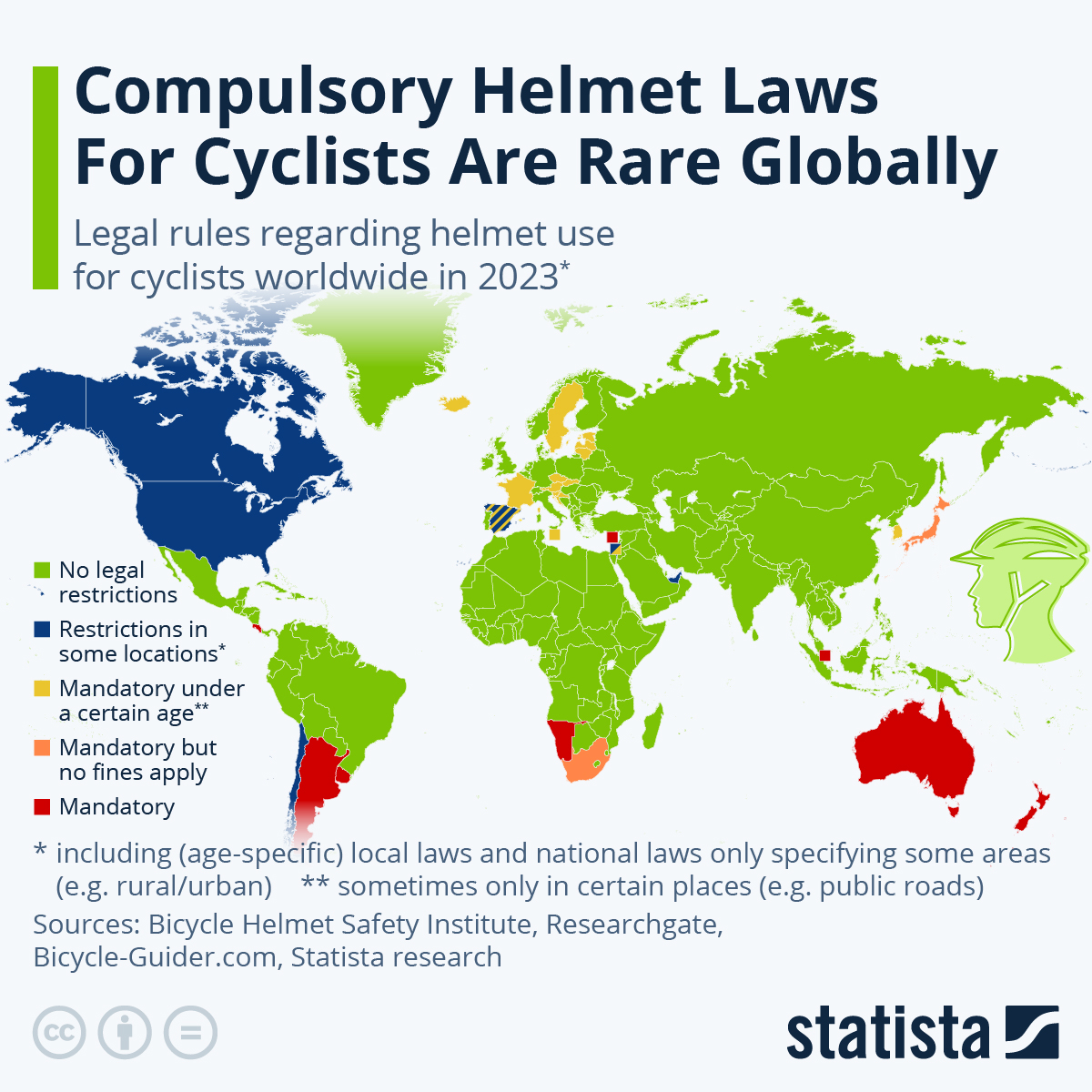 You will find more infographics at Statista
Helmet use remains one of the most effective measures for reducing severe trauma in motorcycle crashes.
Head injury remains a leading cause of motorcycle fatality, and helmet compliance directly lowers the chance of brain injury, permanent disability, and death.
Public health research shows consistent protective outcomes tied to helmet use. Measured benefits include the following:
- 69% reduction in head injury risk
- 37% reduction in death risk for operators
- 41% reduction in death risk for passengers
Crash data also shows unhelmeted riders face far greater danger. Motorcyclists without helmets are approximately 40% more likely to suffer fatal head injury compared with helmeted riders.
Repeals of universal helmet laws have shown measurable negative public health effects. Arkansas and Texas experienced sharp declines in helmet use after repeal, paired with major increases in fatalities.
Fatal motorcycle operator deaths rose by:
- 21% in Arkansas
- 31% in Texas
Helmet use among crash victims in Arkansas dropped dramatically after repeal, falling from around 55% to below 30% within a year. Trauma registry data also showed that head injury treatment costs increased substantially after these legal changes.
Higher helmet compliance produces system-wide health benefits.
Emergency response burdens decline, rehabilitation costs decrease, and long-term disability outcomes become less severe when helmet use rises statewide.
Public health systems experience reduced strain when helmet protection becomes standard practice, even in regions where legal mandates remain partial or absent.
Closing Thoughts
Universal helmet laws remain the most effective approach for reducing serious motorcycle injuries and fatalities.
Interstate travel can present challenges because helmet regulations differ widely between states.
Consistent helmet use offers critical protection even in states without legal mandates, making helmets an essential safety choice for every rider.