
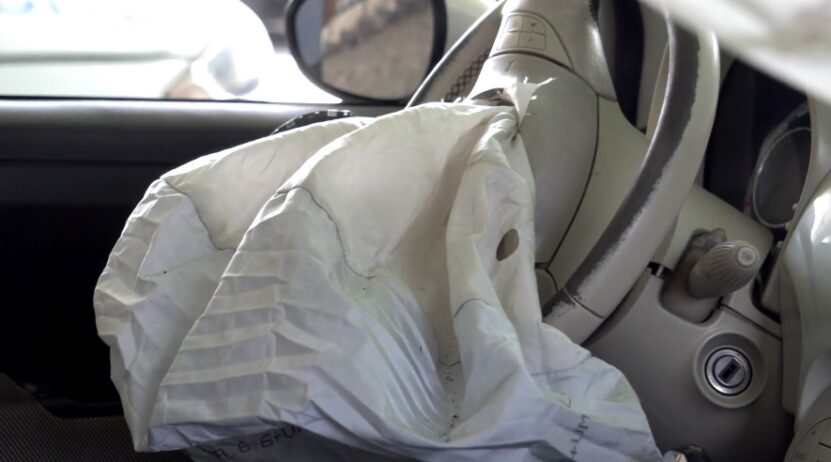
Airbags are supposed to save lives. They sit silently behind your dashboard, waiting for that split second where they’re needed most. And when they do their job right, they can mean the difference between walking away from a crash or not.
NHTSA estimates that frontal airbags have saved more than 50,000 lives since their widespread introduction in the late 1980s through 2017. That’s a staggering number. But when airbags fail, especially in violent, unexpected ways, the result can be devastating.
We’re talking about exploding airbag pass-throughs. These aren’t your typical non-deployments or minor malfunctions. This is when an inflator turns into a fragmentation grenade. It’s metal, chemicals, and extreme pressure, all going the wrong direction.
And even worse? Most vehicle inspections never catch it.
Let’s break down how that happens, who’s been affected, and why it’s not as rare as it should be.
Exploding Airbag Pass-Throughs Explained

When an airbag deploys correctly, it’s fast, loud, and violent, but it’s controlled. The inflator ignites a chemical reaction, rapidly producing gas to inflate the airbag in about 30 to 50 milliseconds. You get a cushioned impact, not a catastrophic one.
Now imagine that same inflator explodes instead of inflating the bag. The housing ruptures. Shrapnel blasts through the airbag, into the driver or passenger, and sometimes even exits the vehicle. That’s a pass-through.
It’s not a fluke. It’s happening. And the names you’ll hear most are ARC and Takata.
When an inflator turns into a fragmentation grenade, you might need legal help; reach out to a Tampa Auto Accident Lawyer.
ARC Automotive
ARC inflators have been under federal investigation for years. The issue stems from defective welds or blocked pathways inside the inflator.
When the airbag is triggered, gas builds up, and instead of escaping properly, the pressure overwhelms the metal housing. Boom. The inflator explodes, and metal shards become high-speed projectiles.
Injuries and deaths have already occurred. And yet, as of now, there’s no full-scale recall like with Takata. The NHTSA continues to press ARC for accountability, but the defect is tough to spot – and even tougher to prove during inspections.
Takata
The first recalls linked to Takata airbag inflator ruptures actually began in 2001–2002 with models like the Isuzu Rodeo, Honda Accord, and Acura TL.
However, the widely declared global crisis, driven by a surge in incidents and massive recalls, really took off in 2013–2014, culminating in a peak recall phase.
Over 67 million vehicles in the U.S. have been recalled, and more than 100 million globally. The issue? They used ammonium nitrate as a propellant, and it’s a chemistry problem waiting to happen.
Ammonium nitrate breaks down when exposed to heat and humidity over time. As it degrades, it becomes unstable. And when it goes off, it doesn’t inflate the airbag, it explodes. Metal parts in the inflator rupture and blast forward.
Why Inspections Keep Missing the Problem
@noahglenncarter Millions of cars are potentially unsafe because of their airbags #foryou #cars #airbag
It’s easy to assume that your annual inspection covers everything. But it doesn’t. Especially not the airbags. Here’s why.
1. They’re Not Part of Most State Inspections
Let’s take Missouri. The State Highway Patrol has stated that airbags aren’t part of their safety check. They direct drivers to the NHTSA instead.
Pennsylvania? Same deal. Unless it’s a special enhanced inspection, airbags don’t factor in.
Many states follow that same model. If your airbag light isn’t on, and you’ve got tires, brakes, and wipers that work, you’re good to go.
2. The Defects Are Buried Deep
ARC inflators have microscopic weld failures. Takata’s problem is chemical degradation inside a sealed chamber.
You can’t see that from the outside. You can’t even diagnose it with a scan tool in most cases. These inflators look fine. They sit quietly in your dash until it’s too late.
3. Warning Lights Are Unreliable
You might assume the airbag warning light will tip you off. But not always.
There are vehicles with faulty inflators that don’t trigger a light at all.
And there are cases, like a 2010 VW Jetta reported by a New Jersey driver, where the light stays on because of a minor wiring issue, even though the airbag system is functional.
So even if your light is off, or on for the “wrong” reason, you’re flying blind.
4. No Universal Testing Requirement
Brakes are tested. Headlights are tested. Seatbelts, too. But airbags? Not required.
Some states, like Massachusetts do require airbags to be in good working order, but there’s still no requirement to test their actual performance.
No inflator tests. No propellant assessments. No scans unless the tech happens to check it.
5. Inspection Tools Can’t Catch It
Even a well-meaning inspector is limited by the tools they have.
- No inflator pressure testing
- No chemical stability diagnostics
- No disassembly of airbag modules
- No detailed system scans unless specifically requested
The best they can usually do is check the SRS light and plug in a basic scanner. That won’t reveal a degraded propellant or a faulty weld.
6. Time and Money
Adding thorough airbag inspection to every vehicle check would take serious time. And time is money.
Most inspection shops aren’t equipped to spend 30 minutes on your airbags alone. They’re trying to move vehicles through efficiently. Digging into inflators would mean:
- Specialized equipment
- Expensive training
- Liability exposure
Most shops aren’t prepared for that, and regulators haven’t pushed for it yet.
7. Used Car Market Shenanigans
This one’s ugly.
When airbags deploy in a crash, they’re supposed to be replaced with factory-standard components. But in the used car market, some shady dealers skip that step. They’ll:
- Re-stuff a steering wheel with a dummy airbag
- Install a counterfeit unit
- Disable the SRS system entirely
And since inspections don’t always catch those things, unsafe cars get sold.
Real-World Consequences

Let’s put it into perspective with a few numbers and stories.
| Issue | Details |
| Takata Recall Scale | 67 million vehicles in the U.S. |
| Unrepaired Takata Vehicles | About 6 million still on the road |
| Takata-Related Deaths | At least 23 in the U.S. |
| Takata-Related Injuries | Over 250 serious injuries |
| ARC Airbag Investigation | Ongoing with multiple injuries and fatalities |
| Lives Saved by Airbags | 4,330 in 2019 alone; 70,059 total by 2019 |
When airbags work, they’re heroes. When they don’t, they’re time bombs.
What Can Actually Be Done?

If you’re reading this and wondering how the system could be so broken, you’re not alone. Here are a few things that might move the needle.
Mandate Airbag System Checks
Yes, it would be a big shift. But states could start requiring at least a basic diagnostic scan of the SRS system during inspections. That alone would help flag disabled systems or fake replacements.
Require Recall Repairs Before Sale or Renewal
Don’t let people register or sell a car that has an open airbag recall. Make the repair a prerequisite. Some states are testing this idea, but it’s not widespread yet.
Force the Manufacturer’s Hand
When companies like ARC resist a recall, the government has to push harder. The NHTSA has the authority, but enforcement can be slow and political.
Improve the Recall System
Right now, you have to go to the NHTSA website and enter your VIN. It’s useful, but passive. Imagine if you got push alerts, DMV warnings, or even text messages when your car had an open recall. That kind of engagement would boost compliance.
Educate Consumers (Without Freaking Them Out)
The more drivers know about their airbags, the more likely they are to act. Dealerships, mechanics, insurance companies, and even schools, there are ways to educate without triggering mass panic.
How to Check Your Own Car Today
If you’re reading this and thinking, “Wait, what if I’ve got one of these ticking time bombs?” – good news: you can check.
- Go to https://www.nhtsa.gov/recalls
- Enter your full 17-digit VIN
- Look for any open recalls related to airbags
- If there’s an open recall, get it fixed, free of charge
Summary
We’ve gotten used to thinking of airbags as a permanent fixture in car safety. And for good reason: they’ve saved tens of thousands of lives. But the system behind them isn’t foolproof. When regulators move slowly, when inspections don’t include critical components, and when manufacturers drag their feet, people pay the price.
Exploding airbag pass-throughs aren’t some technical footnote. They’re a live issue, affecting millions of drivers. They expose a gap in how we inspect, certify, and regulate safety tech that’s supposed to protect us.
And until that gap is closed, inspections will keep missing the very thing that could kill you in a crash, not the impact itself, but the device meant to save you from it.